

Dusk in At-Turaif, the historic heart of Diriyah, has the color of cooling clay and tastes of ancient dust. It is easy to lose perspective here. Standing among these ruins, while imagination conjures images of glass skyscrapers from neighboring nations, one must remember the essential truth: Diriyah is not Dubai.
Here, currency is not the blinding glare of novelty, but memory. And memory in the desert can be capricious—it can vanish like a mirage.
The greatest challenge of "Vision 2030" is not engineering, but emotion. How do we make the modern tourist feel the weight of 1,500 years of history without feeling overwhelmed? How do we use 21st-century technology not to obscure the desert's raw beauty, but to help reveal it?
A Mirage on the Mud Wall: When Technology Tries to Touch the Soul of Diriyah
Dusk in At-Turaif, the historic heart of Diriyah, has the color of cooling clay and tastes of dust. It is easy to lose perspective here. When you hear about the sixty-three billion dollars pumped into these ruins, the imagination—fed by images from neighboring nations—conjures visions of glass and steel.
But Diriyah is not Dubai. Here, currency is not blinding glitter, but memory. And memory in the desert can be as capricious as a mirage.
Saudi Arabia is racing against time, trying to stitch ultramodernity with archaic heritage. A question arises that torments investors and conservators alike: how to make these silent, raw walls speak to a generation that views the world through a smartphone filter? How not to turn the sanctity of history into a garish theme park, while simultaneously not boring the guest with a dusty museum display?
The "Broadway" of the Desert
During one industry conversation about the future of this place, I heard a sentence that sounded like a diagnosis of our times: "It has to be Broadway." Because today's tourism—the kind seeking deeper sensations—is essentially theatre. It is the Experience Economy. And Diriyah is a stage waiting for its actors.
We don't have to look far for them. The script has lain in this sand for fifteen hundred years. It is the epic, painful tale of Antara ibn Shaddad, the poet-warrior, and his unrequited love for Abla. An Arabian Romeo, born of these stones, whose poems still resonate in the region today.
But how to tell this story so it doesn't become just another track on an audioguide? The answer may lie at the intersection of the latest technology and the ancient nature of the desert.
وَلَقَد ذَكَرتُكِ وَالرِماحُ نَواهِلٌ مِنّي وَبيضُ الهِندِ تَقطُرُ مِن دَمي
فَوَدَدتُ تَقبيلَ السُيوفِ لِأَنَّها لَمَعَت كَبارِقِ ثَغرِكِ المُتَبَسِّمِ
The Digital Dissolving
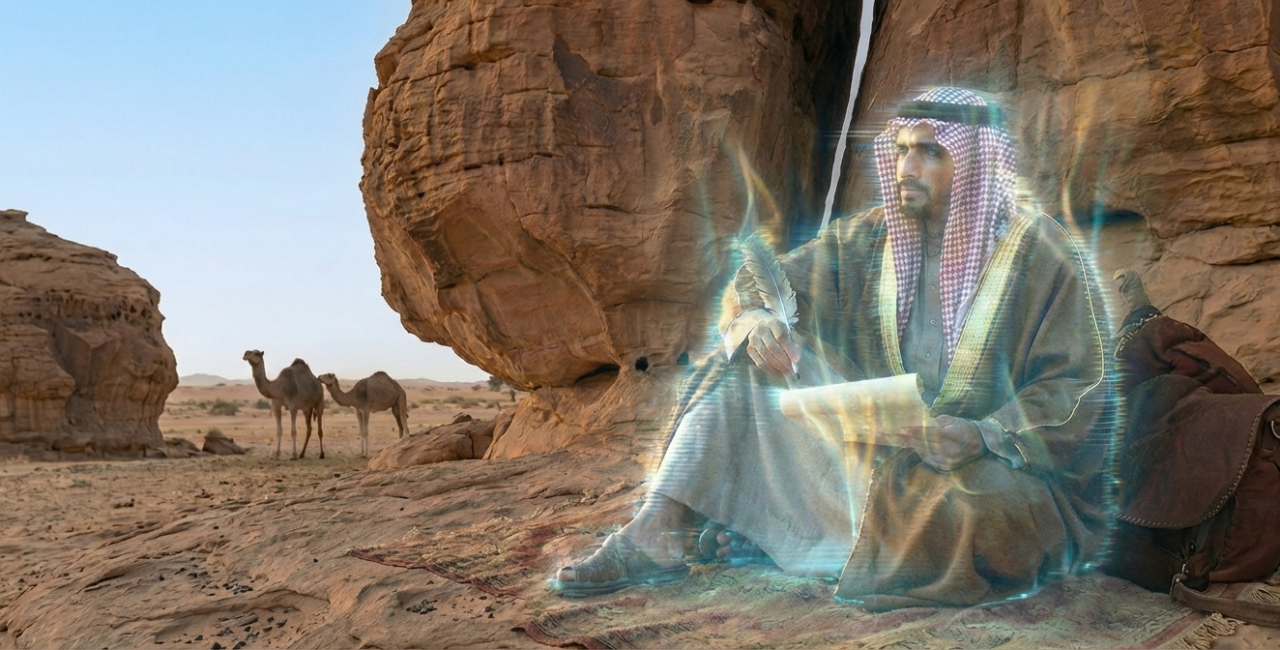
Let’s imagine this moment. A narrow, winding alley between restored mud-brick houses. The thickening gloom. Suddenly, amidst the ruins, a shimmering, translucent figure appears. A holographic Antara, unreal, woven from light, reciting verses about longing. He looks like the ghost of this place, momentarily broken free from non-existence.
Curiosity bids you closer. And here is the crucial shift. In the digital world, we are accustomed to images disappearing on demand, like a switched-off screen. Here, however, technology imitates nature.
As you approach the figure, it disperses. It blows away in the wind like a mirage trembling on the horizon, returning to the void.
A Physical Afterimage
The digital mirage vanishes, but it leaves a physical afterimage. This is the moment where theatre turns into an intimate experience.
In the spot where the phantom trembled just a moment ago, your hand encounters rough reality. It might be a fragment of a poem freshly carved into the clay plaster—words you just heard. Perhaps a few carnelian beads scattered on the path, looking like relics lost by Abla centuries ago. Passive sightseeing turns into an emotional search for traces.
There is something deeply honest in this idea regarding the nature of this place, which has always deceived wanderers with mirages. Paradoxically, the most advanced technology—holograms, augmented reality—serves here only as a lure. It is meant to catch the eye, induce a shiver, and then withdraw into the shadows, leaving the human alone with the physical weight of history.
The Ritual of the Shattered Jug
But this experience also has the power to ignite hearts here and now. And it is already happening before our eyes.
The legend of Antara and Abla is still alive in this sand. It tells that one day, as Abla was collecting water, Antara’s gaze—filled with such potent, overwhelming love—caused the clay jug in her hands to shatter into tiny pieces.
Today, visitors moved by this story find raw clay shards around the ruins. To them, this is not debris. In a spontaneous, emerging ritual, they treat them as relics of that passion. Lovers—or those still waiting for a love of such impact—take these fragments in their hands. They whisper to them their promise of an eternal bond or a quiet prayer to find such love.
Then, together, they bury this symbol in the sand at the foot of the ruins.
The desert—eternal, silent, and mighty—becomes the guardian of their secret vow. Just as it guarded Antara's poetry for fifteen centuries before we allowed it to resonate again. It is the moment where their personal story intertwines with the legend of the place.
image: In the place where the phantom trembled just a moment ago, a hand encounters rough reality. It might be a fragment of a poem freshly carved into the clay plaster – words you just heard
The Script Hidden in the Sand
Because Diriyah, despite all those billions, ultimately doesn't need more concrete. It needs a touch of poetry, ephemerality, and theatre. It needs a mirage that allows you to believe the past is within arm's reach, before it dissolves once again into the hot air.
And now, hands up—who doesn’t have at least a small tear in their eye reading about those shards?
Now, think honestly: would you cry over an Excel spreadsheet showing $63 billion spent on infrastructure?
Exactly.
We build with concrete and massive budgets. But we connect with a place through the heart, shattered jugs, and whispered promises. And that is what the true "Experience Economy" is all about. It is the difference between an expensive construction site and a Destination that changes people.
Related Articles



GlobNet Marketing
In today's fast-paced and constantly changing market, modern enterprises confront a variety of difficulties.
GlobNet Marketing
adress:
Aleja NMP 35 lokal 6
42-202 Czestochowa
Poland
Mob +48 501 272 121
NIP PL949 005 21 89