

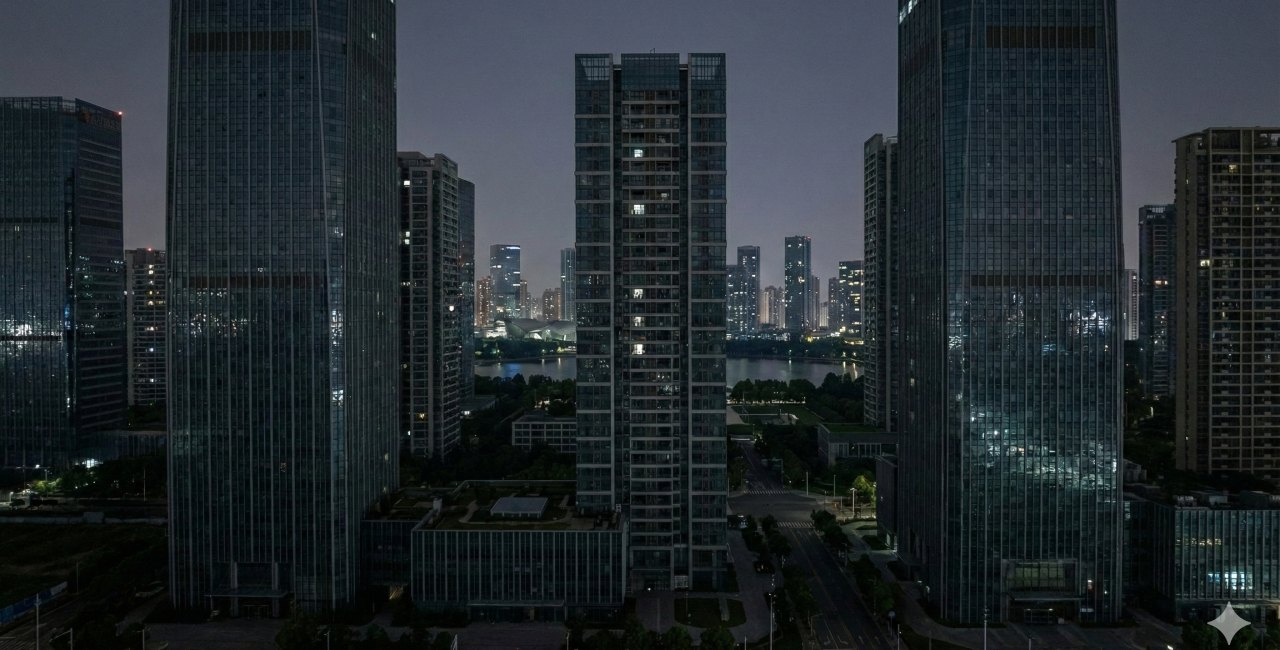
Concrete Melancholy. When Chinese Cities Wait for People Who Are Yet to Be Born You stand in the middle of a six-lane avenue. The asphalt is so fresh it still smells of tar and promise.
The traffic lights meticulously measure time: red, amber, green. Everything works perfectly, like a Swiss watch, with one small exception – you are alone here.
There are no cars for these lights to affect. There are no pedestrians waiting for the "green men". Welcome to the Chinese ghost town. This is not a post-apocalyptic vision after a neutron bomb explosion. This is a vision of the future that simply... hasn't arrived yet.
Chinese Ghost Cities: Where They Build First and Hope People Will Come. BECAUSE THAT'S HOW THEY DO IT IN CHINA
I'm sitting on a train from Beijing to Lhasa, thinking: "Oh, another housing estate." But something feels off. I look – it's a housing estate like any other, high-rises, boulevards, even a fountain on the roundabout. Except that… there's no one. Literally. Zero people. Zero cars. Zero life. Zero. It's not that there are few people. It's that there's ABSOLUTELY NO ONE. As if everyone suddenly vanished, and the city was left behind.
And then it hit me. This is that famous CHINESE GHOST CITY. Not the one in Inner Mongolia that everyone writes about. This is somewhere in central China, between one million-person city and another. And there are more places like this than you think.
First Concrete, Then People. And If They Don't Come? Too Bad.
This isn't an accident. It's a MODEL. In Poland, in the West, a city grows organically. People arrive, build houses, need shops and schools, so they build them. In China? The opposite. First, the authorities draw A NEW, BIG, FANTASTIC CITY on the map. They buy the land from farmers, and then… the concrete pours. And not just any concrete.
Within a few years, the entire infrastructure is up:
Cookie-cutter high-rises – all in the same color, all identical. As if poured from a mold.
Six-lane avenues – where one motorbike or a donkey cart drives by (I saw it!).
Huge shopping malls – with names like "Galaxy Joy Prosperity Mall," their shutters down.
Parks with perfect lawns – that no one walks on.
Schools and hospitals – brand new, smelling of paint, ready for thousands of students and patients who aren't there.
And it all just stands there. And waits. It waits for the people who – in theory – are supposed to move en masse from the countryside to the cities. Except that sometimes… they don't come. Or they come, but maybe five families per thousand apartments. And you get this picture: in one building, across 20 floors, a light is on in two windows. The rest is darkness. Eerie, evening darkness.
Why Do They Look Like This? The Reasons Are (Surprisingly) Logical.
Speculation, folks. These aren't homes to live in. These are assets. Securities in the form of an apartment. Chinese people buy apartments en masse as an investment. They prefer to keep their money in concrete rather than in a bank. They buy, lock up, forget. And wait for the price to go up. The apartment stands empty, but on paper, it's making money. The result? A city full of homes, but without residents.
Orders from Above. Often, building a new district isn't a matter of demand, but of the five-year plan. The local government got an order: "Increase the urbanization rate by X%." How do you do that? You build a new city, and the rate goes up! Will anyone live there? That's a problem for later. What matters is fulfilling the plan and boosting local GDP (because the construction itself provides a lot of jobs).
A Forced-Pace Relocation. Sometimes, people do move in. Because their old village was flooded for a dam. Or they were expropriated for a factory. Then entire villages are "relocated" to such new apartment blocks. They become city dwellers overnight. Except they have no jobs in this new city, no community. So sometimes… they go back. Or they leave the apartment empty "for show" and go look for work elsewhere.
What's It Like Up Close? Like Walking Through a Movie Set
I once managed to enter such a ghost city. Not in Mongolia, but in Hebei province, near Beijing. It was an incredible feeling. As if I were the last person on Earth.
Sound: Silence. Unnatural, depressing silence in the middle of a city. You could only hear the wind between the high-rises.
School: A playground with brand-new rubberized surface, goalposts, but zero kids. Torn plastic sheeting on one of the classroom windows.
Shop: The one and only open convenience store in the whole complex. The shopkeeper looked at me as if I were a ghost. I bought water and chips. The saddest purchase of my life.
Bus stop: A timetable from 2018. The bus ran once every three hours. Maybe.
This isn't a "failed city." This is a city in hibernation. Everything is ready. You just need to press the "PLAY" button. Except no one knows if anyone will ever press it.
Is This a Failure? Not Entirely
And here's the most interesting part. What looks to us like failure and waste, for China is part of a long game. Urbanization is a strategic goal. They are building ahead of demand. Because they know that in 20-30 years, these cities will be needed.
Some of these "ghosts" after 10-15 years start to come to life
Some of these "ghosts" after 10-15 years start to come to life. Companies arrive, factories, young people. Slowly, ever so slowly, more lights turn on in the windows. The fountain on the roundabout is finally turned on.
Traveling by train through China, looking at these seemingly empty cities, we see not so much a failure, but the materialization of patience. The patience of a state that thinks in terms of centuries, not election cycles. And faith – sometimes blind faith – that "if you build it, they will come."
And for now, the streetlights shine there. On empty streets. For no one.
Related Articles



GlobNet Marketing
In today's fast-paced and constantly changing market, modern enterprises confront a variety of difficulties.
GlobNet Marketing
adress:
Aleja NMP 35 lokal 6
42-202 Czestochowa
Poland
Mob +48 501 272 121
NIP PL949 005 21 89