

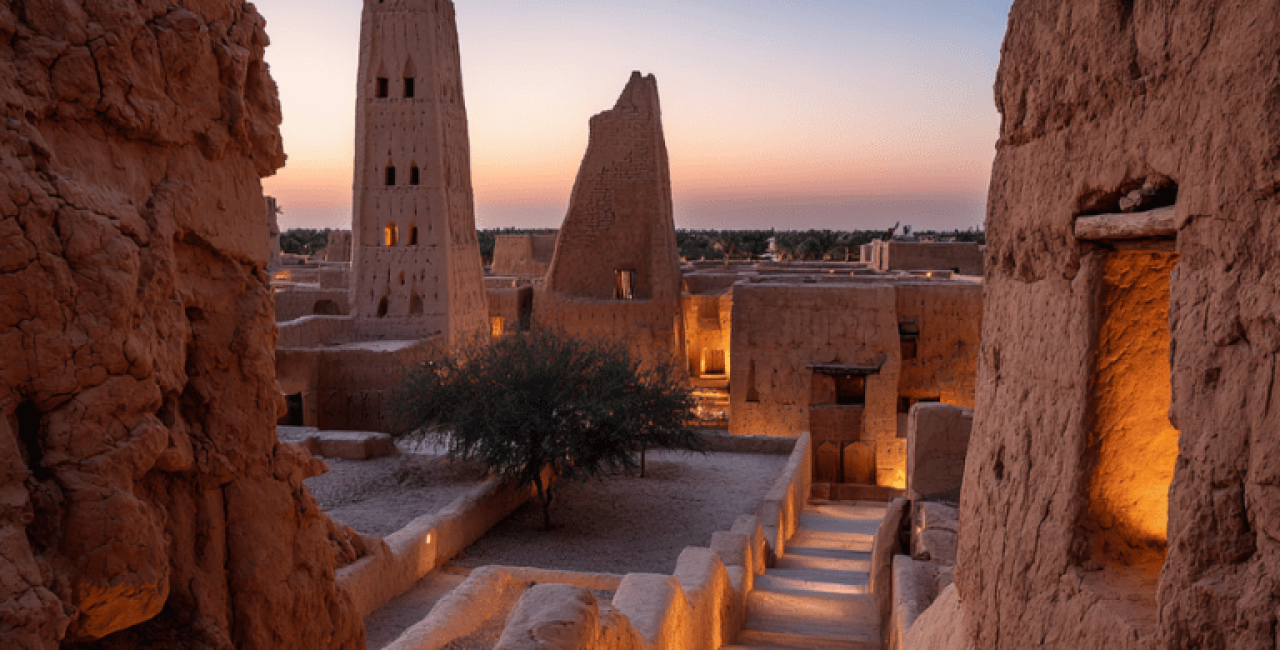
Can you imagine a construction project with a budget exceeding the GDP of many nations, where the main goal isn't to build futuristic glass skyscrapers, but to return to the roots? Welcome to Diriyah Gate—a place where deep history meets unimaginable luxury.
Just minutes away from the bustling center of Riyadh, one of the most ambitious projects of Saudi Arabia's "Vision 2030" is taking shape. It is a staggering $63 billion endeavor aimed at transforming the historic birthplace of the Saudi state into a global hub for culture, heritage, and tourism.
Diriyah Gate: How Saudi Arabia is Building a Bridge to the Past for $63 Billion
When you think of Saudi Arabia’s "Vision 2030," you probably picture the sci-fi mirrors of The Line or the towering skyscrapers of Riyadh. But the Kingdom’s most ambitious project might actually be made of… mud.
Diriyah Gate is a paradox: a historic ruin being transformed into a global super-hub of luxury and culture with a price tag that rivals the GDP of some nations. It is an architectural experiment on a massive scale, proving that the future doesn't always have to look like a spaceship.
What exactly is Diriyah?
To understand the scale of this project, we have to travel back in time. The heart of Diriyah is the At-Turaif district, a UNESCO World Heritage Site. It was here, in the 18th century, that the First Saudi State was born. It was here that the Al Saud family resided.
For years, this site was a ruin. Today, it is becoming the beating heart of a massive ecosystem designed to attract millions of tourists annually.
Najdi Architecture: Luxury in Mud and Clay
What distinguishes Diriyah Gate from other "giga-projects" (like the futuristic NEOM) is its profound respect for tradition. You won’t find glass and steel here. The entire project is based on the traditional Najdi architectural style.
Key features include:
- Buildings constructed from mud-brick (adobe).
- Distinctive geometric cutouts in the walls for ventilation and decoration.
- Narrow alleyways designed to provide natural shade.
The developers are dedicated to authenticity, hand-making millions of mud bricks to preserve the historic character of the site, while simultaneously outfitting the interiors with state-of-the-art technology and modern luxury.
What will Diriyah Gate offer?
The numbers behind this project are dizzying. Upon completion, Diriyah is set to become a self-sustaining city within a city. The master plan includes:
- Hotels & Resorts: Over 38 luxury hotels from world-renowned brands (including Ritz-Carlton, Four Seasons, and Aman), all designed in the Najdi style.
- Culture: Dozens of new museums and art academies.
- Gastronomy: Over 100 restaurants, including Michelin-starred venues (many of which are already open at Bujairi Terrace).
- Living: Luxury residences for 100,000 inhabitants, schools, a university, and recreational areas.
Fun Fact:
Saudi Arabia aims to attract 27 million visitors annually to Diriyah by 2030. It is envisioned as the "Saudi version" of the Roman Colosseum or the Greek Acropolis—a must-visit landmark on every traveler's map.
Why does this matter?
Diriyah Gate is more than just a tourist attraction. It is a symbol of Saudi Arabia’s transformation. A country that has been closed off for decades and relied primarily on oil is now opening up to the world, showcasing its cultural identity. It is an attempt to diversify the economy, but also a way to retell its own history—on a scale that only the Kingdom can afford.
🗺️ Practical Guide: 5 Things You Must See in Diriyah
If you are planning a trip to Diriyah Gate (especially during the winter season when the weather in Riyadh is perfect), here are 5 attractions that are open now and are sure to impress:
1. At-Turaif District (UNESCO) The absolute heart of the complex. Walking through the labyrinth of restored alleyways feels like time travel. Be sure to visit in the evening—the lighting on the clay walls and the spectacular 3D projection mapping on the ruins create a magical atmosphere that photos just can't capture.
2. Bujairi Terrace A paradise for foodies with a billion-dollar view. Here you will find over 20 world-class restaurants (including Hakkasan, Long Chim, and Tatel). The highlight? Dinner on a terrace with a direct, unobstructed view of the illuminated At-Turaif district across the valley.
3. Salwa Palace The largest and most impressive structure in At-Turaif, once the home of the ruling Al Saud family. It is an icon of Saudi history, featured in many promotional images. It's worth visiting the Diriyah Museum located within the palace ruins to see historical artifacts.
4. Wadi Hanifah Diriyah isn't just walls; it’s an oasis. Wadi Hanifah is a natural river valley that offers a break from the desert landscape. You'll find beautiful parks, walking trails, and thousands of date palms here. It's the perfect spot for a stroll before hitting the museums.
5. JAX District Something for modern art fans. Although technically just outside the historic core, JAX is an industrial district transformed into a vibrant creative hub. Former warehouses now host art galleries, artist studios, and installations (this is where the famous Diriyah Contemporary Art Biennale takes place).
Summary
Diriyah Gate is proof that modernity doesn't have to mean cutting ties with the past. It is a fascinating urban experiment that combines desert history with the vision of a global tourism superpower. If you are planning a trip to the Middle East in the coming years, this place should definitely be on your bucket list.
Let see
image
Related Articles


GlobNet Marketing
In today's fast-paced and constantly changing market, modern enterprises confront a variety of difficulties.
GlobNet Marketing
adress:
Aleja NMP 35 lokal 6
42-202 Czestochowa
Poland
Mob +48 501 272 121
NIP PL949 005 21 89