

Google Ads in the Travel Industry B2C: How to Effectively Combine Reach with Conversion
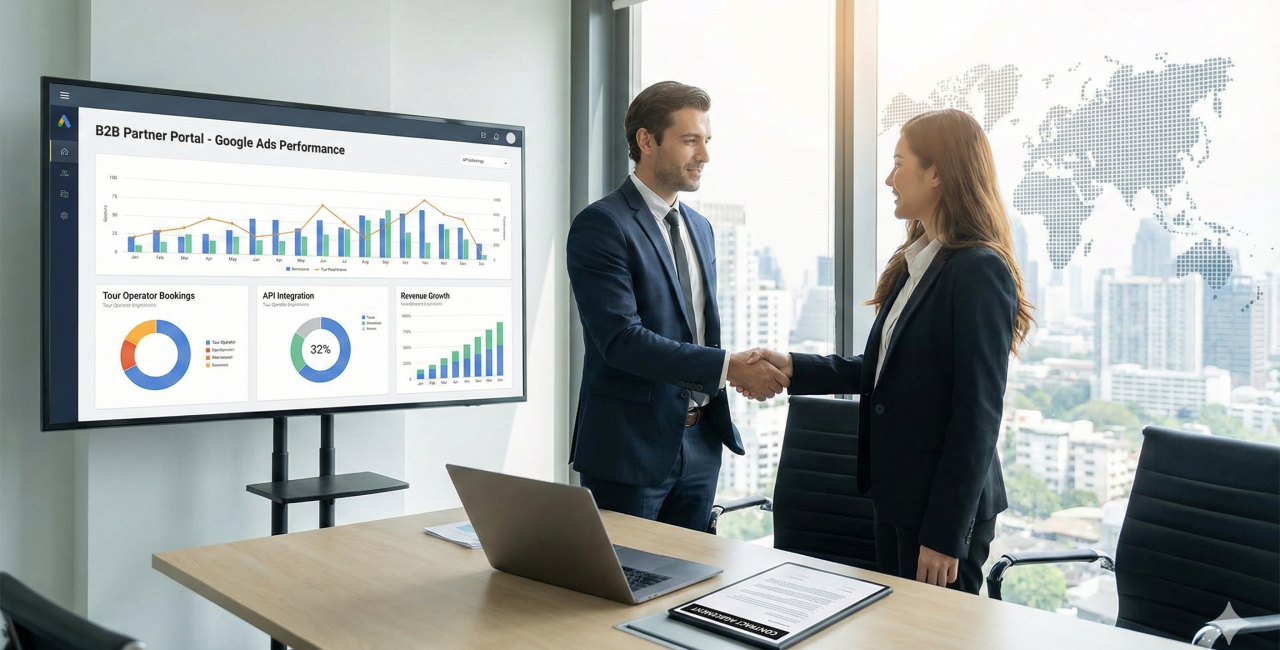
Google Ads in the Travel Industry: How to Effectively Combine Reach with Conversion
The travel industry is one of the most competitive environments in digital marketing. The Customer Journey is rarely linear – a tourist first "dreams," then looks for inspiration, compares prices, checks reviews, and only then books. Therefore, in Google Ads, you cannot rely on a single campaign type. The key to success is a seamless transition between strategies, adapted to the stage the customer is at.
Below is a proven operating model that combines building reach with precise conversion.
1. Inspiration Stage: Why is the impression strategy crucial?
At the very beginning, a potential customer often doesn't know where they want to go yet. They are looking for inspiration. At this moment, fighting for a "click" might be too expensive and inefficient. This is where impression-based strategies (CPM/vCPM) come in.
Goal: Plant the Seed (Brand Awareness)
In travel, we sell dreams and views. Your goal is to reach a wide audience with a visually attractive message (banners, YouTube videos) so your brand or destination sticks in their memory.
- Strategy: Choose vCPM (cost per thousand viewable impressions).
- Where to run it: Google Display Network (GDN) and YouTube.
- Why it matters: If you skip this stage and focus only on sales, you will compete solely on price with the giants (like Booking or Airbnb) at the very bottom of the sales funnel. Building awareness ensures that when the customer starts planning a vacation, your brand feels "familiar" to them.
2. The "Secret Ingredient": Strategy based on registered users
This is the moment mentioned earlier, often overlooked by marketers. Do you have users on your site who have already registered, signed up for a newsletter, or created a loyalty account? This is your most valuable asset (so-called First-Party Data).
Utilizing Customer Lists (Customer Match)
Instead of shooting in the dark, use data about users who have already trusted you.
- Feeding the algorithm: Upload encrypted email lists of your registered users to Google Ads.
- Similar Segments (Optimized Targeting): Google will find people on the web with a behavioral profile similar to your best, registered customers. This is much more effective than standard interest targeting.
- RLSA (Remarketing Lists for Search Ads): You can set higher bids for people already in your database when they type general terms into Google, e.g., "holidays in Greece". You know these are valuable users, so it's worth paying more to win them back.
Tip: A registered user returning to the site is much closer to a purchase than a new visitor. Treat this group as a priority.
3. Transition to Specifics: Pay-Per-Click (CPC) Strategies and Conversions
When a customer moves from the "dreaming" phase to the "planning" phase, their way of using the search engine changes. They type specific phrases: "Hotel with pool Zakopane," "Flights to Barcelona June." Here you must switch to a performance strategy.
From CPC to Smart Bidding
This is the moment to "close" the sale.
- Manual CPC / Enhanced CPC: Good for the start to feel out the market and control the costs of specific keywords.
- Target ROAS (Return On Ad Spend): In travel, this is the absolute foundation. If you know the average margin on a trip is X, you can set the algorithm to aim for a specific return on investment.
- Maximize Conversions: If your goal is to fill hotel spots at any cost (e.g., Last Minute), this strategy works best, even if the cost per acquisition (CPA) is slightly higher.
Hybrid Model: The best players use reach strategies (point 1) to generate cheap traffic, and CPC strategies (point 3) for remarketing – i.e., "chasing" those who saw the ad but haven't bought yet.
4. Additional tips for the travel industry
Besides the bidding strategy itself, technical details matter in tourism:
Seasonality and Schedule
The travel industry lives in seasons.
- First Minute: Advertise in advance (Jan/Feb for summer), promoting benefits of early booking (lower price, guaranteed spot).
- Last Minute: Urgency counts here. In ad copy, use countdowns ("Only 2 rooms left!", "Sale ends in 3h").
Ad Assets (formerly Extensions)
Take up as much space on the phone screen as possible:
- Location assets: Show how close your facility is to the beach or center.
- Price assets: Show "from" prices to attract attention (e.g., "Stays from $150").
- Image assets: Add a small photo next to the text ad in search. In travel, an image sells better than 1000 words.
Negative Keywords
Don't waste budget on "browsers." Strictly exclude words like: free, job, reviews, forum, wiki. You want to reach someone who wants to buy, not just read.
Mobile First
Most travel searches (especially during the trip) happen on smartphones. If your site isn't responsive, even the best CPC strategy will throw money down the drain. Ensure the booking process on mobile is short and intuitive.
Summary
An effective Google Ads campaign in tourism is a relay race:
- Start with reach (impressions) to inspire.
- Use registered user data to guide algorithms to the right target group.
- Finish with an aggressive CPC/ROAS strategy to capture the customer at the moment of the purchase decision.
Only combining these three elements guarantees a stable stream of bookings while maintaining profitability.
Related Articles




GlobNet Marketing
In today's fast-paced and constantly changing market, modern enterprises confront a variety of difficulties.
GlobNet Marketing
adress:
Aleja NMP 35 lokal 6
42-202 Czestochowa
Poland
Mob +48 501 272 121
NIP PL949 005 21 89