

Billions Hidden in Concrete: How a Single TV Show Frame Turns an Ordinary Breakwater into a Tourism Goldmine
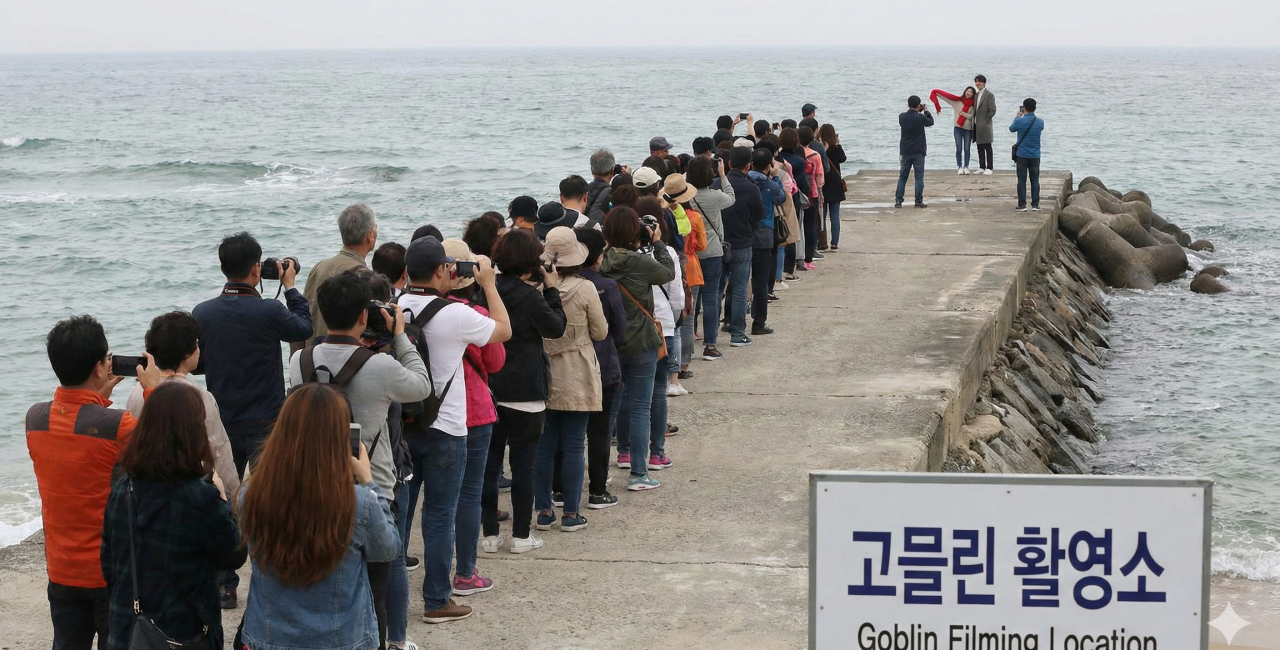
Look at the photo above. What do you see?
In theory: nothing special. It’s an ordinary concrete breakwater in the Korean city of Gangneung, battered by cold sea winds. There are no UNESCO World Heritage sites here, no natural wonders, no luxury infrastructure.
In practice: you are looking at one of Asia’s hottest tourist attractions.
Every day, a long queue of tourists from all over the world forms on this scrap of concrete. They wait patiently, often holding a red scarf – an essential prop. The goal? To stand on the edge and, for a few seconds, feel like the protagonists of the iconic drama "Goblin," recreating the famous romantic scene.
This single image says more about modern tourism than hundreds of reports. It is the perfect proof of the sheer power of storytelling. In South Korea, ordinary infrastructure becomes a premium attraction, and on-screen fiction generates billions of dollars in the real economy.
Investors and the tourism industry are asking themselves: Is this "Instagrammable Korea" just a temporary viral hit, a bubble about to burst?
As trend analysts, our answer is: This is not a fad. This is a powerful new branch of the economy. Here is why K-drama tourism is a goldmine.
The Netflix Effect: How K-Dramas Reshaped South Korean Tourism
Forget travel brochures. South Korea is proving that in 2025, the most effective tourism marketing strategy is a hit TV show.
Imagine queuing on a cold, windswept concrete breakwater. There are no UNESCO sites here, no natural wonders. Just concrete and sea. Yet, tourists flock to this spot in Gangneung just to recreate a 10-second romantic scene from the drama "Goblin."
This is "Set-jetting"—traveling to locations known from the screen—and South Korea has become its undisputed global capital.
Many dismiss this as a fleeting "Instagram trend." They are wrong. It’s a sophisticated economic engine backed by decades of soft power strategy.
📊 The hard data for 2024 (via Korea Tourism Organization) proves it: ✈️ Over 16.37 million tourists visited Korea (nearing pre-pandemic highs). 🎯 Over 35% of them are under 30 years old. 🎬 For nearly 1/3 of these young travelers, "K-content" (dramas, movies, music) was the primary motivator to book a ticket.
1. It’s Not a Fluke. It’s a Strategy
Many people mistake Hallyu (the Korean Wave) for a one-off hit, recalling the "Gangnam Style" craze of 2012. This is a mistake. What we are seeing now, at the end of 2025, is the result of decades of systematic work by the South Korean government, which treated pop culture as a strategic export product – on par with Samsung semiconductors or Hyundai cars.
Global streaming platforms like Netflix haven't invested billions of dollars in Korean productions without reason. They know that the K-drama fan is characterized by extraordinary loyalty. The statistical viewer doesn't just watch one series; they become immersed in this world for years. This generates constant, long-term demand for travel, not just a one-time spike in interest.
2. Set-jetting: The Next Generation of Tourism
The tourism industry coined the term "set-jetting" (traveling to locations known from the screen). South Korea has become the undisputed world capital of this phenomenon.
Why is this worth millions? Because series change the definition of a "tourist attraction" and the travel map:
- Ordinary places become premium: A cafe where the protagonists of the hit "Queen of Tears" drank coffee can raise its prices by 50% overnight, and the queues will still get longer.
- Regional revitalization: Thanks to series like "Hometown Cha-Cha-Cha" (filmed in the coastal city of Pohang), tourists are heading to the provinces. This relieves overcrowded Seoul and leaves money in local communities that previously didn't exist on tourist maps.
3. The Numbers Don’t Lie: Emotions Sell for More Than Monuments
This is a key argument for investors and hard proof for the B2B sector. A tourist visiting the Louvre pays for a ticket to see art. A tourist in Korea pays for the feeling of being part of the story.
Hard data confirms this. According to Korea Tourism Organization statistics for 2024, the country was visited by over 16 million tourists, returning almost to pre-pandemic levels. However, the key is who is arriving.
Over 35% of all visitors are people under the age of 30. Research indicates that for nearly one-third of these young travelers, the main motivator for buying a plane ticket was not traditional sights, but "K-content" – movies, series, and music.
This gives rise to the Experience Economy. When a fan visits Gyeongbokgung Palace in a hanbok (traditional attire), they don't do it just for a history lesson. They do it to feel like the protagonist of a historical drama costume piece. People are willing to pay premium prices for luxury VIP tours offering "celebrity-style" makeup workshops or private photoshoots in filming locations.
4. "Instagrammability" Encoded in the DNA
South Korea is a country designed for the camera lens. Here, aesthetics is a religion. Cafes are designed so that every chair and dessert looks perfect in a photo. Cities offer fascinating contrasts – from cyberpunk neons to extremely traditional wooden hanok villages.
For Gen Z and Millennials, Korea is currently the most "photogenic" destination in the world. As long as Instagram and TikTok rule travel decisions, Korea will remain on top.
Verdict: Invest, But Wisely
K-pop and K-drama culture is not a bubble – it is a solid trend with psychological and economic foundations. However, the market is evolving.
The past was cheap coach tours in the style of "see 10 places in 3 days." The future (and the real money) lies in luxury immersive tourism – themed hotels, dinners with menus known from series, and interactive experiences.
Investing in film tourism in Korea today is not a gamble. It is entering one of the best-oiled Soft Power mechanisms in the world, where an ordinary concrete breakwater becomes a pilgrimage site for millions.
What about you? Would you travel to the other side of the world just to see a place from your favorite series? Let us know in the comments!
Related Articles



GlobNet Marketing
In today's fast-paced and constantly changing market, modern enterprises confront a variety of difficulties.
GlobNet Marketing
adress:
Aleja NMP 35 lokal 6
42-202 Czestochowa
Poland
Mob +48 501 272 121
NIP PL949 005 21 89