

More Than "Flight + Hotel": Why Booking Complex Travel Is Like Solving a 3D Puzzle (And How Tech is Automating Top DMC Expertise)
We have all grown accustomed to the convenience of popular booking portals like Book or Expedia. They are indispensable when you need a weekend hotel in Krakow or a simple flight to London. They are like well-stocked supermarkets full of raw ingredients.
But tourism is not just about simple city breaks. The real challenge begins when a client wants a two-week, multi-stop journey through a country like India.
That is when traditional booking systems reveal themselves to be merely "service catalogs." They cannot think. They sell the ingredients, but they do not know the recipe for a complex dish. A complex itinerary requires thought, logic, anticipating consequences, and deep knowledge of local realities.
Here is the difference between manually crafting complex programs (the essence of an experienced tour operator/DMC's work) and what ordinary portals offer, and how modern Dynamic Packaging technology is attempting to bridge this gap by automating expert knowledge.
More Than Just "Flight + Hotel." How Technology is Attempting to Mimic the Brain of a DMC Expert
Part 1: The Domino Effect – Logistics on a Macro Scale
For years, I manually crafted travel itineraries to India. It’s work resembling a 3D puzzle, where every piece impacts the others. You cannot simply "buy a hotel and a flight" without analyzing the context.
Let’s look at a concrete example I faced hundreds of times: planning the Delhi – Jaipur – Agra route.
The arrival time in Delhi is not just information on a ticket. It is a decision that determines the program for the next 48 hours. If the client lands in the morning, they will get stuck in traffic and miss Old Delhi. If they land at night, they have a comfortable start the next day.
A Client Preference Disrupts the Puzzle
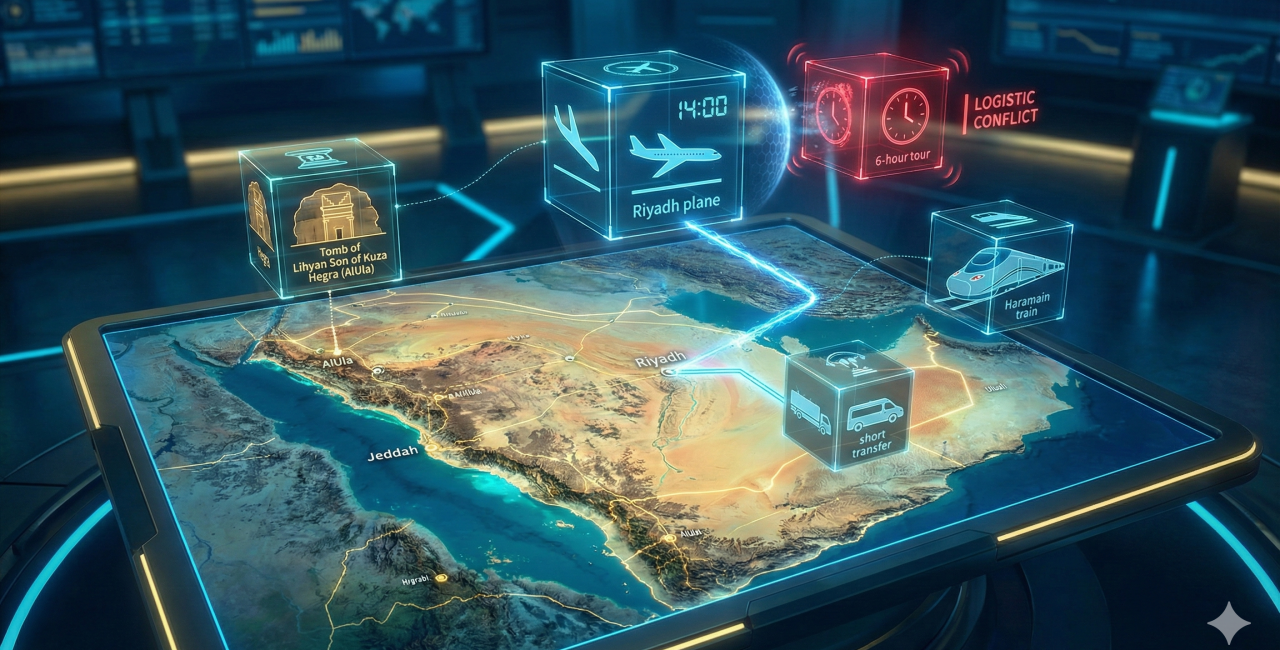
This is the manual assembly of the puzzle. Now, imagine that during the planning stage, when we have a perfect plan with a car transfer to Jaipur (allowing for a crucial visit to the Amber Fort en route), the client states a preference: "I don't like long car rides. I prefer to fly to Jaipur."
In the traditional "shop" approach (like anothe sistem Boo or EX), you simply buy a plane ticket instead of booking a car. Simple? Theoretically, yes. But in real, logistical tourism, this single preference disrupts the entire intricate puzzle:
- Lost Attraction: By choosing the flight, we bypass the land route and cannot visit the Amber Fort on the way.
- New Daily Plan: We have to completely change the logistics of two days (airport transfers, the flight itself).
- Consequences: We must "squeeze" the Amber Fort into the next morning.
- End Result: Due to this shift, we will likely run out of time to visit Fatehpur Sikri on the way to Agra in the afternoon.
A single choice of transport changed the program of three days and eliminated a key UNESCO attraction. A traditional booking system will not foresee this – it only sees available flights and hotels, but does not understand the dependencies between them.
Part 2: The Modular Puzzle – Working with "Ready-Made Blocks"
So, how do experts handle this? The real magic of creating complex journeys lies not in inventing every day from scratch. It lies in arranging proven, ready-made modules according to strictly defined rules..
Manual DMC Expert Work: A System of Ready-Made "Blocks"
- My work resembled a "copy-paste" system based on deep destination knowledge. I knew that if a client arrives in Jaipur, I must paste a "Transfer Block." And then what? I had ready-made variants:
- BLOCK A ("Full" Variant): A full-day tour (5-6 hours) of the Old City (Hawa Mahal with entry, City Palace, Observatory). Requirement: A full day starting in the morning.
- BLOCK B ("Express" Variant): A short tour (3 hours) – only key points, Hawa Mahal from the outside. Application: When time is limited, e.g., after a noon arrival.
My role as an expert was knowing which block fits a given situation. If I saw an arrival at 1:30 PM, I automatically "pasted" Block B, knowing that Block A was physically impossible before attractions closed.
The Problem for the Inexperienced Agent
An inexperienced agent, using a standard system, sees a list of tours like items in a shop. Wanting to please a client landing at 2:00 PM, they will sell them the 6-hour tour (Block A) because the client "wants to see everything." The agent sees the product but does not know the constraints. The result? The client is furious on-site because they cannot complete the program.
What Is the Dynamic Packaging Revolution?
True, advanced Dynamic Packaging systems (used by modern tour operators) are an attempt to transfer this "human logic" and system of "blocks" into the world of machines.
It is no longer just a search engine. It is a "rules engine" with encoded DMC knowledge.
How does it look in practice? The system has the same ready-made modules in its database that I used, and it knows the "rules of the game":
- Flight Selection: The client selects a flight to Jaipur arriving at 1:30 PM.
- System Analysis: The engine "sees" the arrival time and checks its rules (the encoded expert knowledge).
- Intelligent Offer: The system knows there is little time left in the day.
- Blocks: The 6-hour tour option (Block A) disappears. The system knows: "I cannot sell this because you won't make it."
- Proposes: The system automatically suggests the 3-hour tour (Block B) as the only logical option.
Summary
True Dynamic Packaging is not a simple sum of flight plus hotel. It is technology that combines expert logic with the speed of the internet and automates the process of arranging proven modules.
Thanks to this, it allows for the instant creation of complex, multi-stage journeys, but – most importantly – it will not allow for a logistical error that would happen in a regular booking portal. This is the difference between buying ingredients and receiving a ready-made, proven recipe for the perfect trip.
Related Articles


GlobNet Marketing
In today's fast-paced and constantly changing market, modern enterprises confront a variety of difficulties.
GlobNet Marketing
adress:
Aleja NMP 35 lokal 6
42-202 Czestochowa
Poland
Mob +48 501 272 121
NIP PL949 005 21 89