

Is your vacation funding a regime, or feeding a family? In a world increasingly divided by geopolitical rifts, traveling to countries like Iran, Myanmar, or Russia has become a moral minefield. From navigating the "financial obstacle course" of a world without SWIFT to facing the ethical dilemma of visiting nations under authoritarian rule—modern exploration requires more than just a passport; it requires a conscience. This article explores the thin line between supporting a dictatorship and building bridges with isolated communities, asking the ultimate question: can tourism succeed where diplomacy fails?
Ethical Tourism in Sanctioned Countries: Building Bridges or Funding Regimes?
Organizing trips to countries subject to international restrictions—such as Iran, Myanmar (Burma), North Korea, or more recently, is one of modern tourism's greatest challenges. It is not merely a logistical game, but primarily a moral and financial one.
Embargoes imposed by the USA, the UN, or the European Union rarely ban tourism per se (with exceptions, such as the ban on using US passports for travel to North Korea), but they effectively cut off the infrastructure necessary to support it.
1. The Financial Obstacle Course: Life Beyond SWIFT
The key problem is not a lack of desire to travel, but the inability to move capital. Cutting off countries like Iran or Russia from the SWIFT system causes a paralysis of standard payment methods.
- Cash is King: Tourists traveling to Iran must bring 100% of their budget in cash (USD or EUR). Western Visa or Mastercard cards are useless there. This creates security risks—the traveler becomes a "walking ATM."
- Cryptocurrency as the New Hawala: Travel agencies are increasingly using stablecoins (e.g., USDT) for instant settlements with local partners, bypassing the traditional banking system.
- Third-Party Intermediation: The "Indonesian method" mentioned in earlier contexts is rare. In practice, the financial hubs for sanctioned countries are most often Turkey, the United Arab Emirates (Dubai), and Armenia. Banks in these countries mediate transfers, though they charge high commissions, raising the cost of trips by 15–20%.
- The Hawala System: This ancient, trust-based value transfer system (which moves value without physical money crossing borders) is experiencing a renaissance in supporting tourism in the Middle East and Central Asia.
2. Ethical Dilemmas: "Travel Boycott" vs. "Engagement"
Tourism in conflict and sanctioned zones divides observers into two camps. Each case requires a different moral assessment.
The Case of Myanmar (Burma): Tourism and Supporting the Junta
Since the 2021 coup, the situation has been clear. Many pro-democracy organizations call for a tourism boycott.
- The Problem: To enter the country, one must pay for a visa and often use infrastructure (airports, railways, luxury hotels) directly owned by generals or their families (so-called crony companies).
- The Dilemma: Tourists wishing to support local guides or owners of small guesthouses inevitably also fund the regime's budget with foreign currency.
The Case of Iran: People vs. Government
Here, the narrative differs. Iran is visited by millions of tourists annually (mainly from neighboring countries, but also from Europe), and sanctions are viewed as great power politics that should not isolate ordinary citizens.
- Perspective: Iranians are known for their extraordinary hospitality (Taarof). The country's isolation makes them thirsty for contact with the outside world. Tourism acts as a safety valve and a window to the world for the local population, who are often critical of their own government.
- Perspective: Iranians are known for their extraordinary hospitality (Taarof). The country's isolation makes them thirsty for contact with the outside world. Tourism acts as a safety valve and a window to the world for the local population, who are often critical of their own government.
3. Hidden Risks: Insurance and Consular Care
An aspect often overlooked in discussions about "embargo tourism" is legal safety.
Important: Standard insurance policies (even "World Premium" ones) often contain exclusion clauses in their General Terms and Conditions (GTC) regarding liability in countries subject to active sanctions or Foreign Ministry warnings (e.g., "Acts of War" clauses or international sanctions).
This means that in the event of an accident in the Iranian mountains or illness in North Korea, a tourist may be left on their own, without the possibility of cashless medical settlement or medical transport. Travel agencies must seek out specialist insurers (often in Asian jurisdictions), which further complicates logistics.
4. Responsible Tourism (Smart Tourism)
Is there a "golden mean"? Instead of a total ban (which historically has rarely led to democratization), experts suggest a model of Conscious Tourism.
- Maximizing "Local Content": Choosing small, family-run guesthouses instead of massive state-owned hotels.
- Avoiding State Transport: Using private drivers instead of state airlines or railways (where possible).
- Pre-departure Education: The tourist must know that their dollars can buy weapons, but they can also feed a guide's family that has lost other sources of income.
Conclusion: Bridges Over Divides
In times of deepening geopolitical polarization, tourism remains one of the last channels of "Track II Diplomacy." A direct meeting between an American and an Iranian at a bazaar in Isfahan does more to de-escalate tensions than a dozen diplomatic notes.
However, traveling to embargoed countries requires the tourist and the organizer to step out of their comfort zone—not just logistically, but ethically. It requires abandoning the role of a passive consumer of sights in favor of being a conscious participant in a complicated political and economic game.
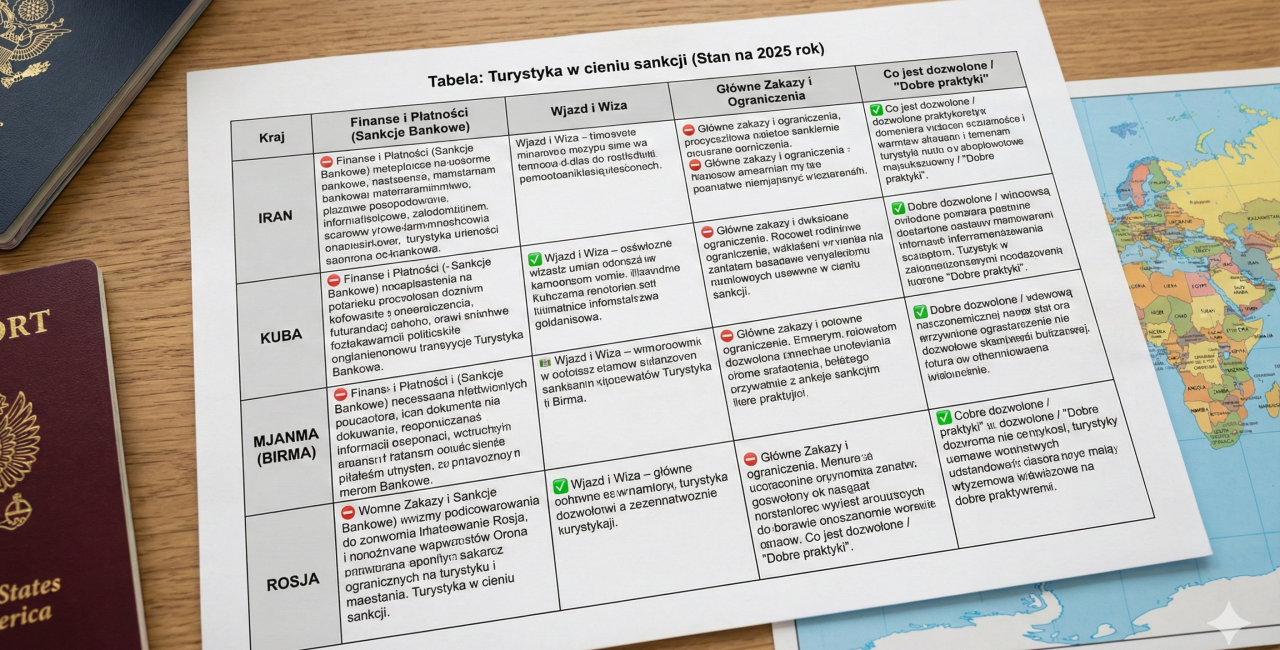
Country | Finance & Payments (Banking Sanctions) | Entry & Visa | Major Bans & Restrictions | What is Allowed / "Best Practices" |
IRAN | SWIFT disconnected. Western cards (Visa, MC) do not work. Cash (USD/EUR) required for the entire stay (the "walking ATM" risk). | Visa: Required (often e-visa). 2025 Update: Rules tightened – individual ("solo") tourism is now practically impossible without a local "sponsor"/guide. | ⛔ No individual tourism (certified guide requirement for US/UK/Canada citizens, increasingly enforced for EU). ⛔ Ban on drones, alcohol. ⛔ Ban on photographing gov/military buildings (espionage risk). | ✅ Organized group tours. ✅ Using "Mah Card" (tourist pre-paid debit card). ✅ Buying handicrafts (carpets) – mind customs export limits. |
CUBA | US Embargo. US cards don't work. EU cards work sporadically (frequent failures, high fees). Recommended: Cash (EUR/USD) exchanged on the black market (official rate is poor). | Visa: "Tourist Card" or new e-visa (since mid-2025). ⚠️ ESTA: Visiting Cuba revokes your right to visa-free US entry (you must apply for a B1/B2 visa for life). | ⛔ For US travelers: Pure tourism is banned by US law. ⛔ Ban on using hotels/restaurants owned by the military ("Cuba Restricted List" by US State Dept). | ✅ Travel under "Support for the Cuban People" category. ✅ Staying in "Casas Particulares" (private homes). ✅ Dining in "Paladares" (private restaurants). |
MYANMAR (BURMA) | Targeted sanctions. Banking system dysfunctional. ATMs often empty. Cash (USD – must be pristine/new notes only) is essential. | Visa: E-visa available, but land borders often closed. Mandatory insurance required (often from a state-owned company). | ⛔ Restricted Zones: No entry to conflict regions (e.g., Rakhine, Sagaing). ⛔ Curfews in many cities. ⛔ Risk of detention for "inappropriate" photos or social media posts. | ✅ Staying in main hubs (Yangon, Bagan, Mandalay) – though ethically debated. ✅ Supporting small, local vendors (avoiding junta-linked chains). |
RUSSIA | Full SWIFT block. EU/US cards do not work. Currency exchange difficult (exchange offices accept USD/EUR, but rates vary). | Visa: E-visa (available for some EU countries, but policies fluctuate based on tensions). ✈️ No direct flights: Access only via third countries (Turkey, Serbia, Dubai). | ⛔ EU Sanctions (2025): Ban on providing tourism services by EU firms in Russia. ⛔ Ban on luxury goods import and cash export above limits. | ✅ Individual travel on your own (if visa is granted). ✅ Using local transport. ⚠️ Note: Western insurance often invalid (due to "sanctioned country/war zone" clauses). |
Related Articles


GlobNet Marketing
In today's fast-paced and constantly changing market, modern enterprises confront a variety of difficulties.
GlobNet Marketing
adress:
Aleja NMP 35 lokal 6
42-202 Czestochowa
Poland
Mob +48 501 272 121
NIP PL949 005 21 89